



IGCSE Economics (0455): What the Past Papers Reveal About Paper 1 & Paper 2
Cambridge IGCSE Economics (0455) is assessed across two very different papers — a 45-minute multiple-choice paper and a longer structured, data-response paper — and each one tests the same six syllabus topics in noticeably different ways. We analysed eight years of Paper 1 data and seven years of Paper 2 data, mapping every question and every mark to its syllabus topic and sub-topic, to see where the exam actually places its weight, how that weight has shifted year to year, and where the two papers agree — or disagree — on what matters most. This report walks through both papers individually, then brings the two together for a subject-wide view that’s useful for anyone planning a focused revision schedule.
Paper 1: Multiple Choice — Topic Distribution
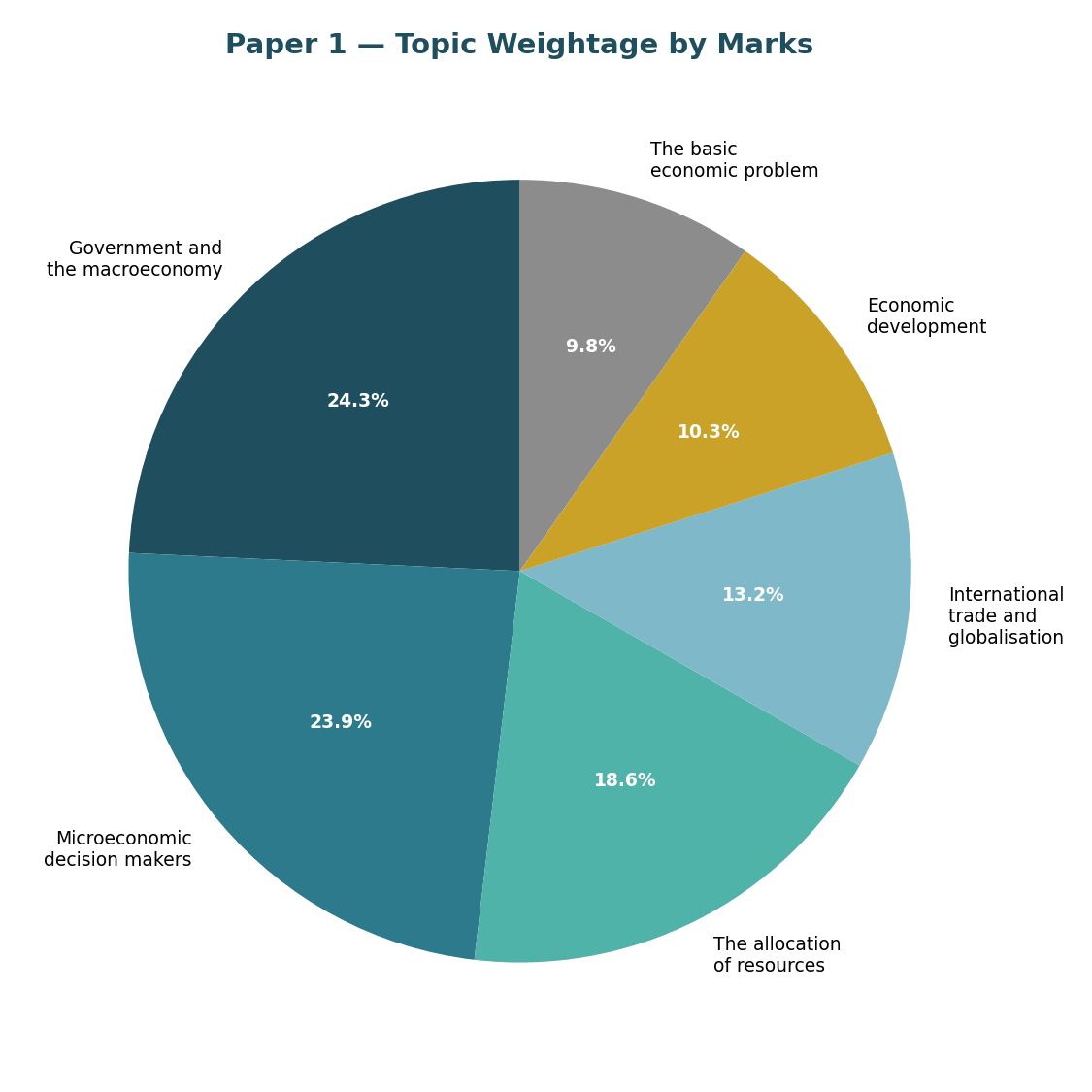
Paper 1 is worth 30 marks in total per session (down from a slightly larger allocation in earlier years — see the year-by-year note below), with every question worth exactly 1 mark. That structural fact matters: because Paper 1 has no partial-credit, multi-part questions, its marks distribution and its question-frequency distribution are identical — a topic’s share of marks is its share of questions. Across the eight years analysed, Government and the macroeconomy leads with 385 marks (24.3% of the paper), narrowly ahead of Microeconomic decision makers at 379 marks (23.9%). Together these two topics account for very nearly half of every Paper 1 sitting.
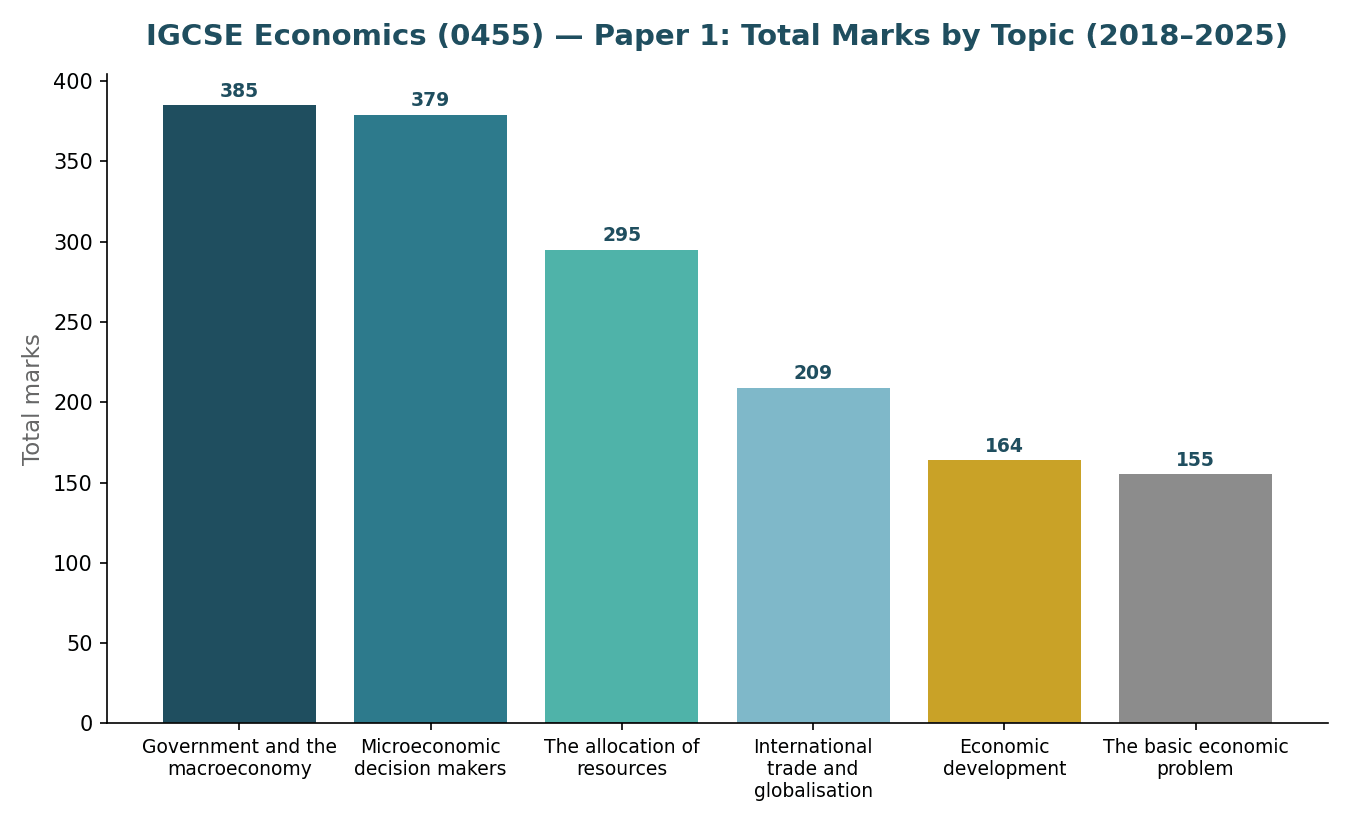
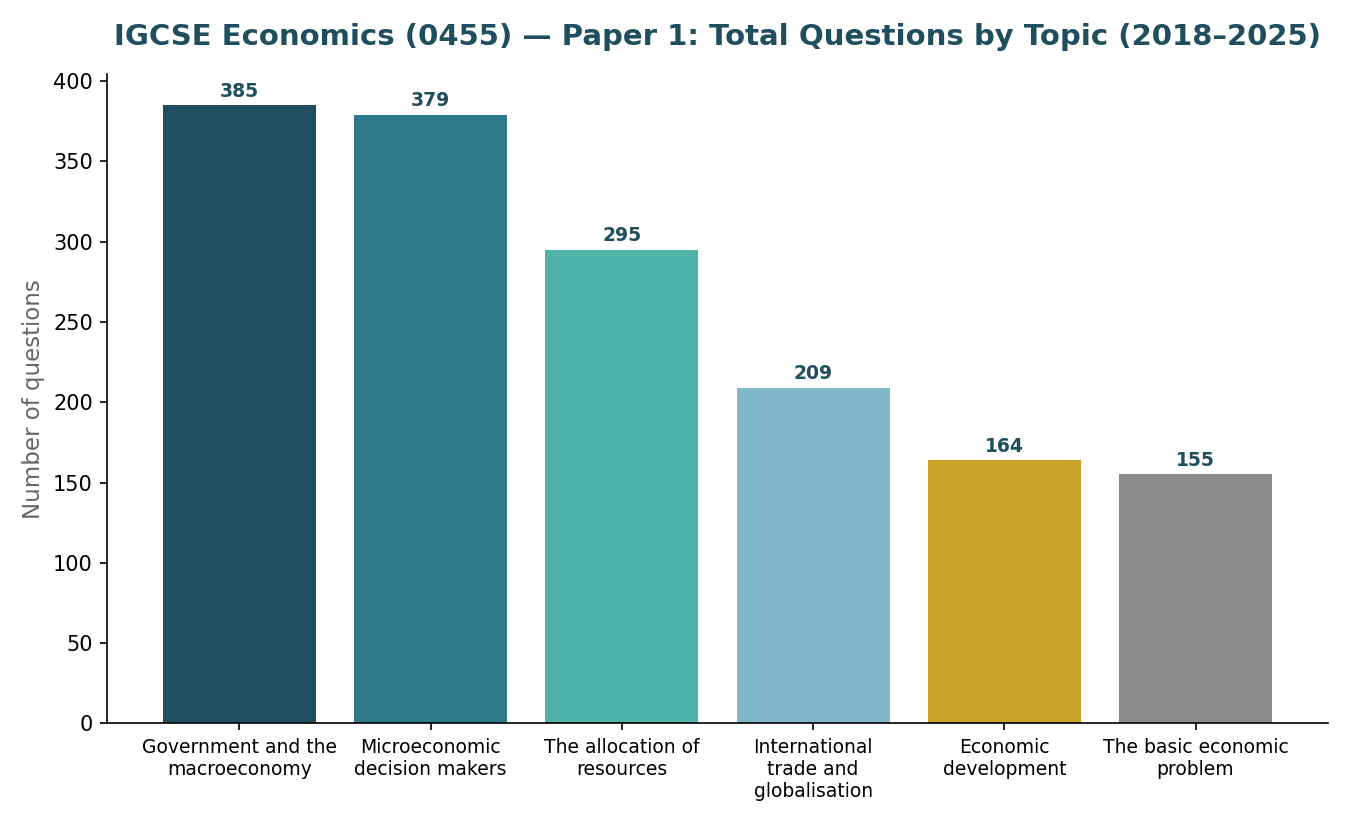
The allocation of resources follows at 295 marks (18.6%), then a clear step down to International trade and globalisation at 209 marks (13.2%), Economic development at 164 marks (10.3%), and The basic economic problem at 155 marks (9.8%). The question-frequency chart below is, by definition, a mirror image of the marks chart — a useful confirmation that Paper 1’s topic weighting is exceptionally stable and predictable in structure, even where the specific questions asked change every year.
Sub-topic deep dive: the four leading Paper 1 topics
Government and the macroeconomy (385 marks / 385 questions)
Within this topic, Fiscal policy is the standout sub-topic at 91 marks (5.7% of the whole paper), followed by Inflation and deflation at 78 marks (4.9%) and Employment and unemployment at 54 marks (3.4%). The role of government, by contrast, appears only 7 times in eight years — the lightest-tested sub-topic anywhere in Paper 1.
Microeconomic decision makers (379 marks / 379 questions)
Firms’ costs, revenue and objectives leads this topic with 83 marks (5.2%), ahead of Firms at 70 marks (4.4%) and Workers at 55 marks (3.5%). Trade unions is the lightest sub-topic here at just 24 marks across the whole period.
The allocation of resources (295 marks / 295 questions)
This topic is unusually evenly spread across its eleven sub-topics, with Price elasticity of demand (PED) and Market failure tied at the top with 41 marks (2.6%) each, followed by Mixed economic system at 31 marks (2.0%). No single sub-topic dominates the way Fiscal policy or Firms’ costs do in the topics above.
International trade and globalisation (209 marks / 209 questions)
Globalisation, free trade and protection is clearly the priority sub-topic at 79 marks (5.0%), with Current account of balance of payments close behind at 69 marks (4.3%). International specialisation trails at just 19 marks.
Reading Paper 1’s mismatch pattern differently
Because every Paper 1 question is worth exactly 1 mark, the usual “high marks-per-question vs. high frequency” mismatch doesn’t apply here — frequency and mark share are mathematically identical. The more useful signal for Paper 1 is consistency vs. concentration:
- Most consistently tested: The basic economic problem holds almost exactly 20–21 marks every single year from 2018–2024 — the most stable topic in the paper.
- Most concentrated in specific sub-topics: Government and the macroeconomy draws over half its marks (169 of 385) from just two sub-topics — Fiscal policy and Inflation and deflation — making it a high-value, narrow-focus revision target.
Year-by-year trend, Paper 1
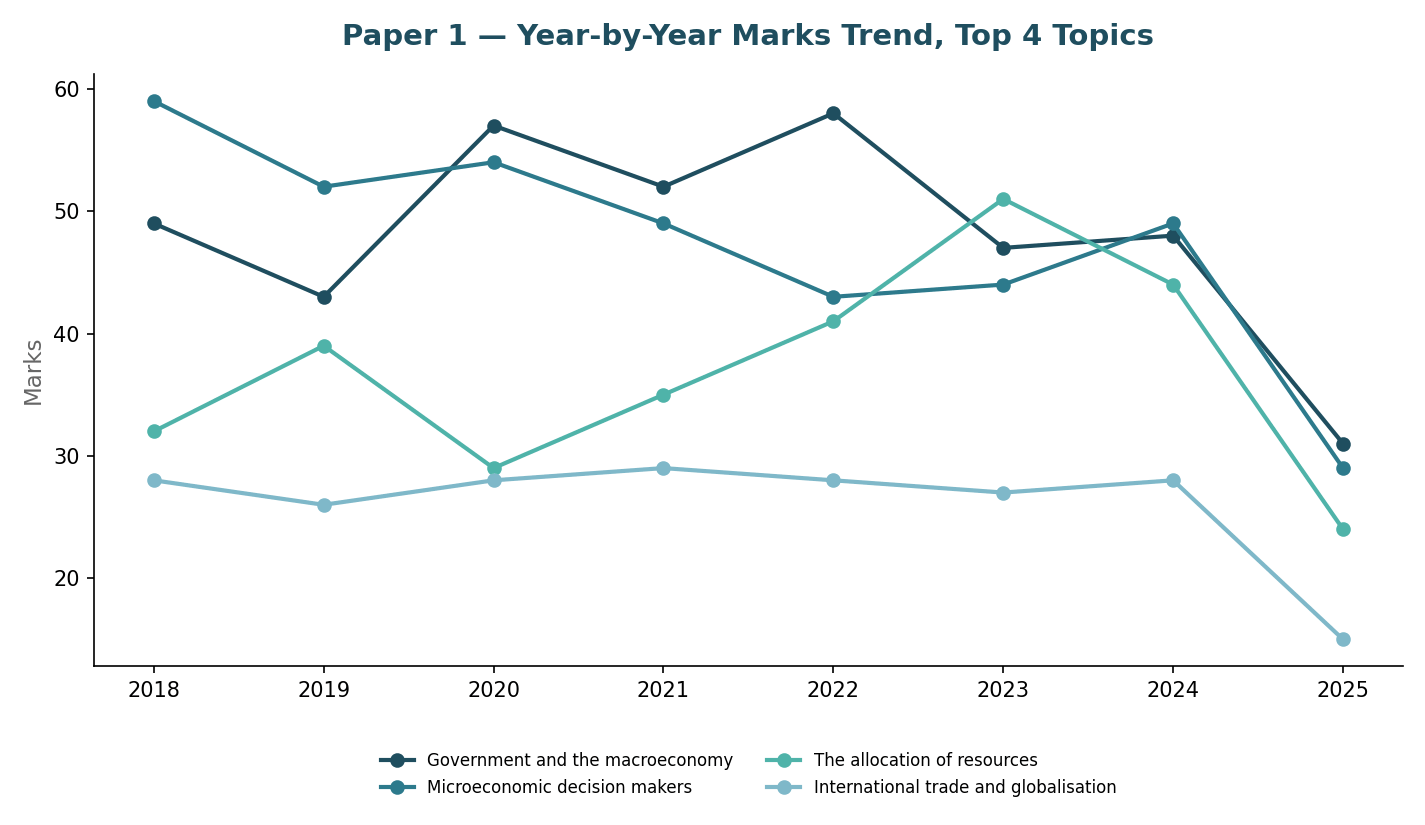
The topic ranking on Paper 1 has stayed remarkably stable across all eight years — Government and the macroeconomy and Microeconomic decision makers have occupied the top two spots in every session. One structural note worth flagging: 2025 shows only 120 total marks against a steady 207–210 in every prior year, indicating the dataset for 2025 currently covers a partial year (likely a single exam series rather than the full year’s variants) rather than a genuine drop in paper length.
Paper 1 summary table
| Topic | Marks | % of Paper | Questions | Marks Rank | Frequency Rank |
|---|---|---|---|---|---|
| Government and the macroeconomy | 385 | 24.3% | 385 | 1 | 1 |
| Microeconomic decision makers | 379 | 23.9% | 379 | 2 | 2 |
| The allocation of resources | 295 | 18.6% | 295 | 3 | 3 |
| International trade and globalisation | 209 | 13.2% | 209 | 4 | 4 |
| Economic development | 164 | 10.3% | 164 | 5 | 5 |
| The basic economic problem | 155 | 9.8% | 155 | 6 | 6 |
Paper 2: Structured Questions — Topic Distribution
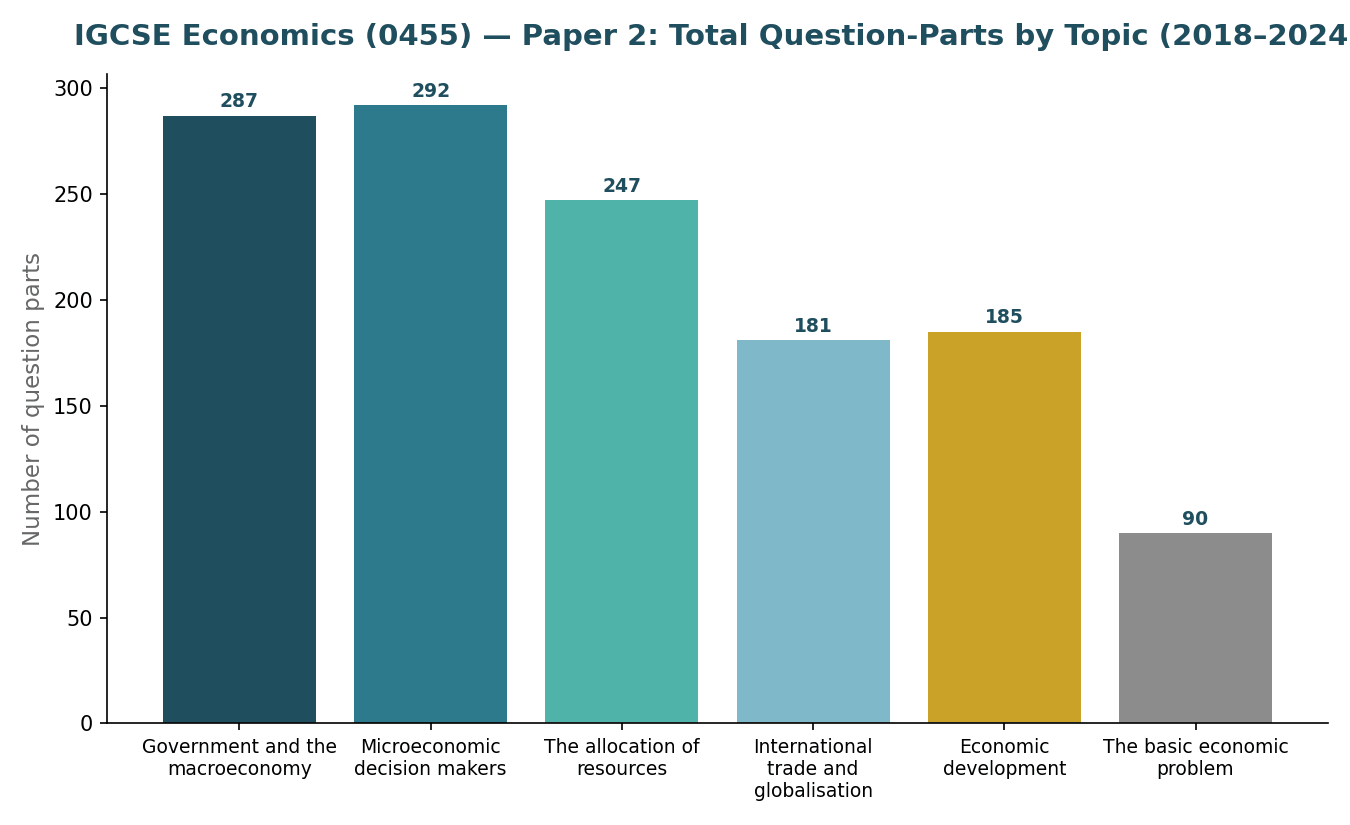
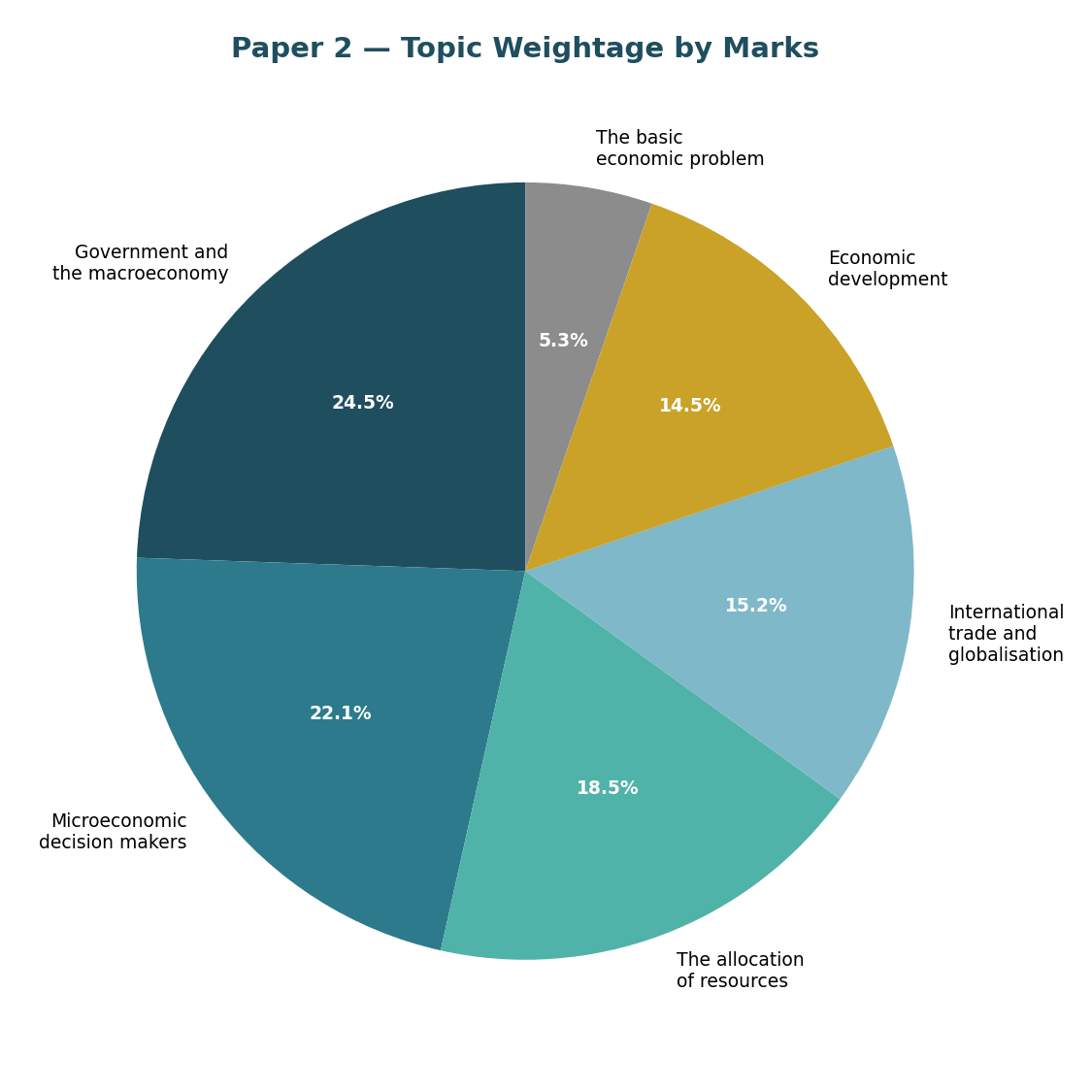
Paper 2 is a different animal entirely: 1,282 individual question-parts across seven years carry 5,950 total marks, at an overall average of 4.64 marks per question-part — meaning most credit here comes from multi-mark analysis, data-response and evaluative sub-questions rather than single-mark recall. Topic weighting is close to Paper 1’s but not identical. Government and the macroeconomy again leads with 1,455 marks (24.5% of the paper), followed by Microeconomic decision makers at 1,312 marks (22.1%) and The allocation of resources at 1,102 marks (18.5%).
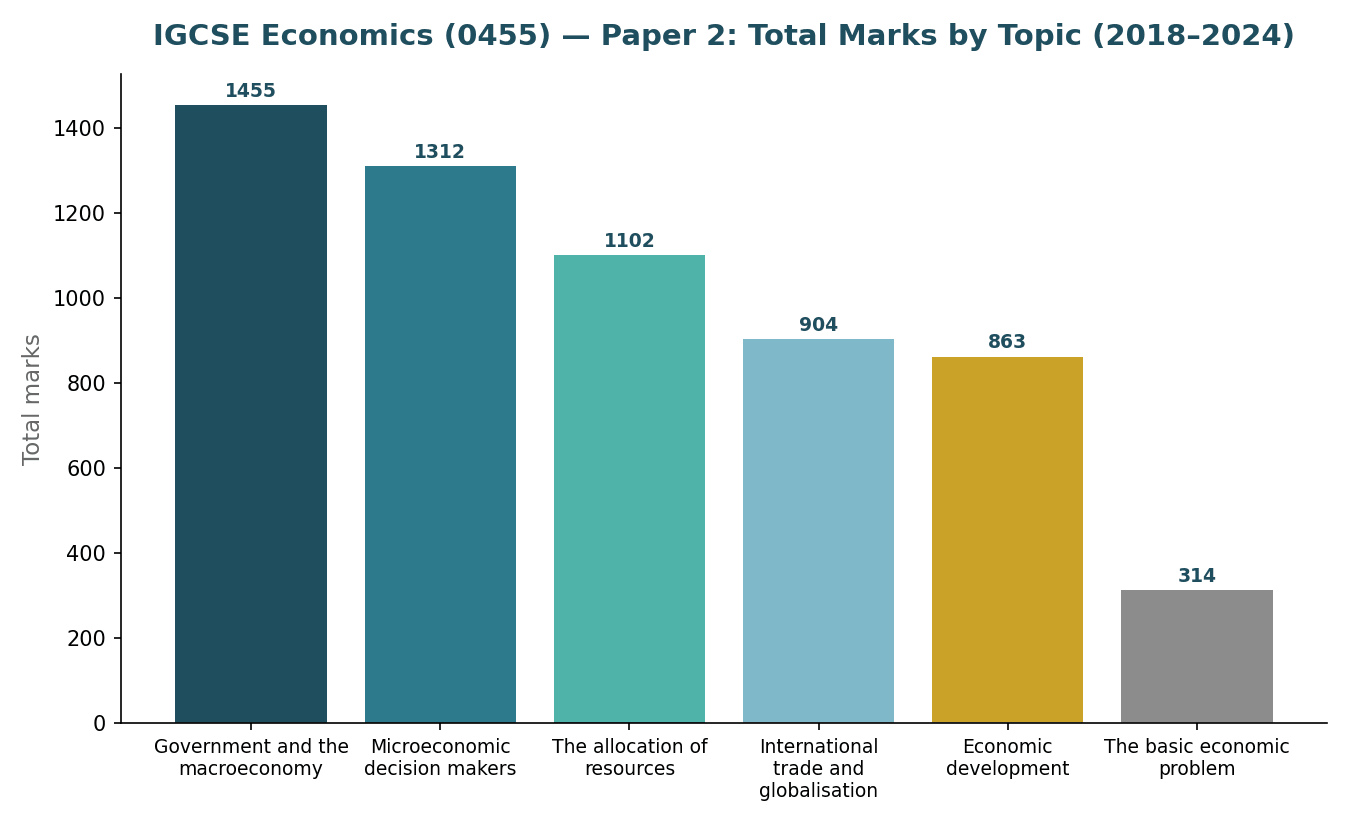
The bigger divergence from Paper 1 shows up further down the ranking: International trade and globalisation carries noticeably more weight on Paper 2 at 904 marks (15.2%) versus 13.2% on Paper 1, and Economic development jumps to 863 marks (14.5%) versus just 10.3% on Paper 1. The basic economic problem, meanwhile, is the lightest topic on both papers but especially so here at just 314 marks (5.3%) — this topic is largely a Paper 1 concern.
Sub-topic deep dive: the four leading Paper 2 topics
Government and the macroeconomy (1,455 marks / 287 question-parts, 5.07 marks/question avg.)
Fiscal policy again leads at 298 marks (5.0% of the paper) across 59 question-parts, closely followed by Inflation and deflation (274 marks) and Economic growth (264 marks). Notably, The role of government — the lightest sub-topic on Paper 1 with only 7 marks — is worth 128 marks on Paper 2 at a high 6.40 marks per question, the highest ratio of any sub-topic in this topic group.
Microeconomic decision makers (1,312 marks / 292 question-parts, 4.49 marks/question avg.)
Firms dominates with 378 marks (6.4% of the whole paper) across 83 question-parts — the single heaviest sub-topic on all of Paper 2. Workers follows at 325 marks. Both sub-topics that were minor on Paper 1 (Trade unions: only 24 marks there) carry real weight here — Trade unions is worth 91 marks on Paper 2, at a high 6.07 marks per question.
The allocation of resources (1,102 marks / 247 question-parts, 4.46 marks/question avg.)
Mixed economic system is the clear leader at 292 marks (4.9%) — a striking contrast to Paper 1, where this same sub-topic ranked only third within its topic. Demand (201 marks) and Market failure (188 marks) follow.
International trade and globalisation (904 marks / 181 question-parts, 4.99 marks/question avg.)
Globalisation, free trade and protection is dominant at 398 marks (6.7% of the whole paper) — the second-heaviest sub-topic on all of Paper 2 after Firms. Current account of balance of payments follows at 228 marks.
Paper 2 mismatch callouts (average: 4.64 marks per question-part)
Sub-topics that punch above their weight (high marks per question relative to how often they appear):
- Market economic system — 6.44 marks/question (116 marks across just 18 questions)
- The role of government — 6.40 marks/question (128 marks across 20 questions)
- Supply-side policy — 6.13 marks/question (92 marks across 15 questions)
- Trade unions — 6.07 marks/question (91 marks across 15 questions)
Sub-topics that appear often but carry lighter mark value per question:
- The factors of production — 2.74 marks/question despite 34 question-parts
- Opportunity cost — 2.86 marks/question across 21 question-parts
- Price determination — 2.91 marks/question across 11 question-parts
- The nature of the economic problem — 3.45 marks/question across 11 question-parts
The pattern is consistent: sub-topics from The basic economic problem tend to appear as shorter, lower-mark questions on Paper 2, while niche policy and market-structure sub-topics — when they do appear — tend to carry disproportionately high marks, often as extended evaluative sub-questions.
Year-by-year trend, Paper 2
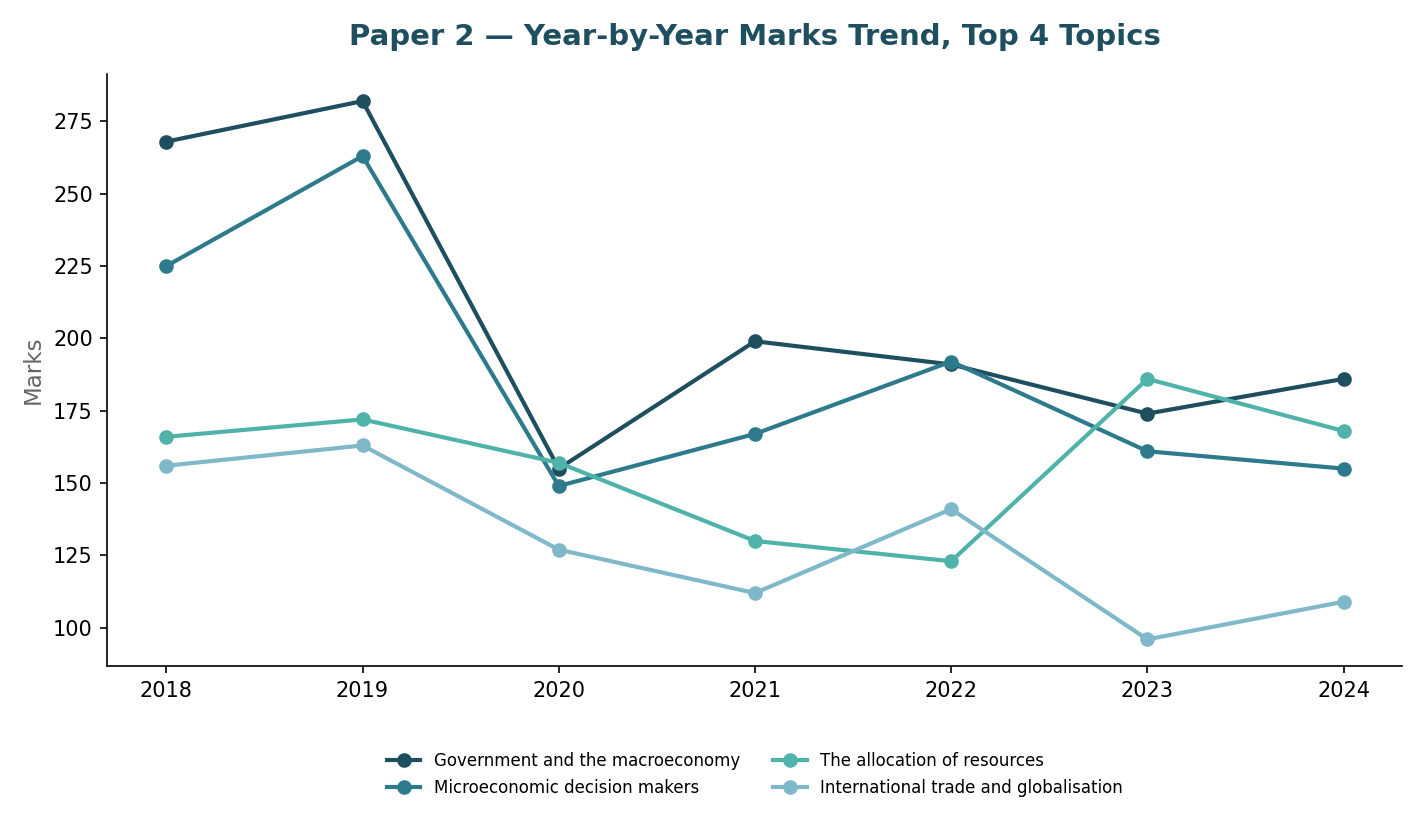
Unlike Paper 1’s steady structure, Paper 2 shows a clear structural shift starting in 2020: total paper marks drop from 1,050 in 2018–2019 to a consistent 770 from 2020 onward — a smaller, more focused paper in every year since. Within that shift, Government and the macroeconomy and Microeconomic decision makers both fell sharply from their 2018–2019 highs (268–282 marks) to the 150–200 mark range from 2020 on, while The allocation of resources held comparatively steady and even rose to 186 marks in 2023, briefly outweighing Government and the macroeconomy that year.
Paper 2 summary table
| Topic | Marks | % of Paper | Question-Parts | Marks/Question | Marks Rank | Frequency Rank |
|---|---|---|---|---|---|---|
| Government and the macroeconomy | 1,455 | 24.5% | 287 | 5.07 | 1 | 1 |
| Microeconomic decision makers | 1,312 | 22.1% | 292 | 4.49 | 2 | 1 |
| The allocation of resources | 1,102 | 18.5% | 247 | 4.46 | 3 | 3 |
| International trade and globalisation | 904 | 15.2% | 181 | 4.99 | 4 | 5 |
| Economic development | 863 | 14.5% | 185 | 4.66 | 5 | 4 |
| The basic economic problem | 314 | 5.3% | 90 | 3.49 | 6 | 6 |
Joint Analysis: What Changes When You Look Across Both Papers
Placed side by side, Paper 1 and Paper 2 agree closely on the top of the syllabus but diverge meaningfully further down. Government and the macroeconomy is the heaviest topic on both papers, at nearly identical shares — 24.3% on Paper 1 versus 24.5% on Paper 2 — making it the single most consistently important topic in the whole subject, regardless of paper format. The allocation of resources shows the same pattern of agreement, at 18.6% and 18.5% respectively — a difference of just 0.1 percentage points.
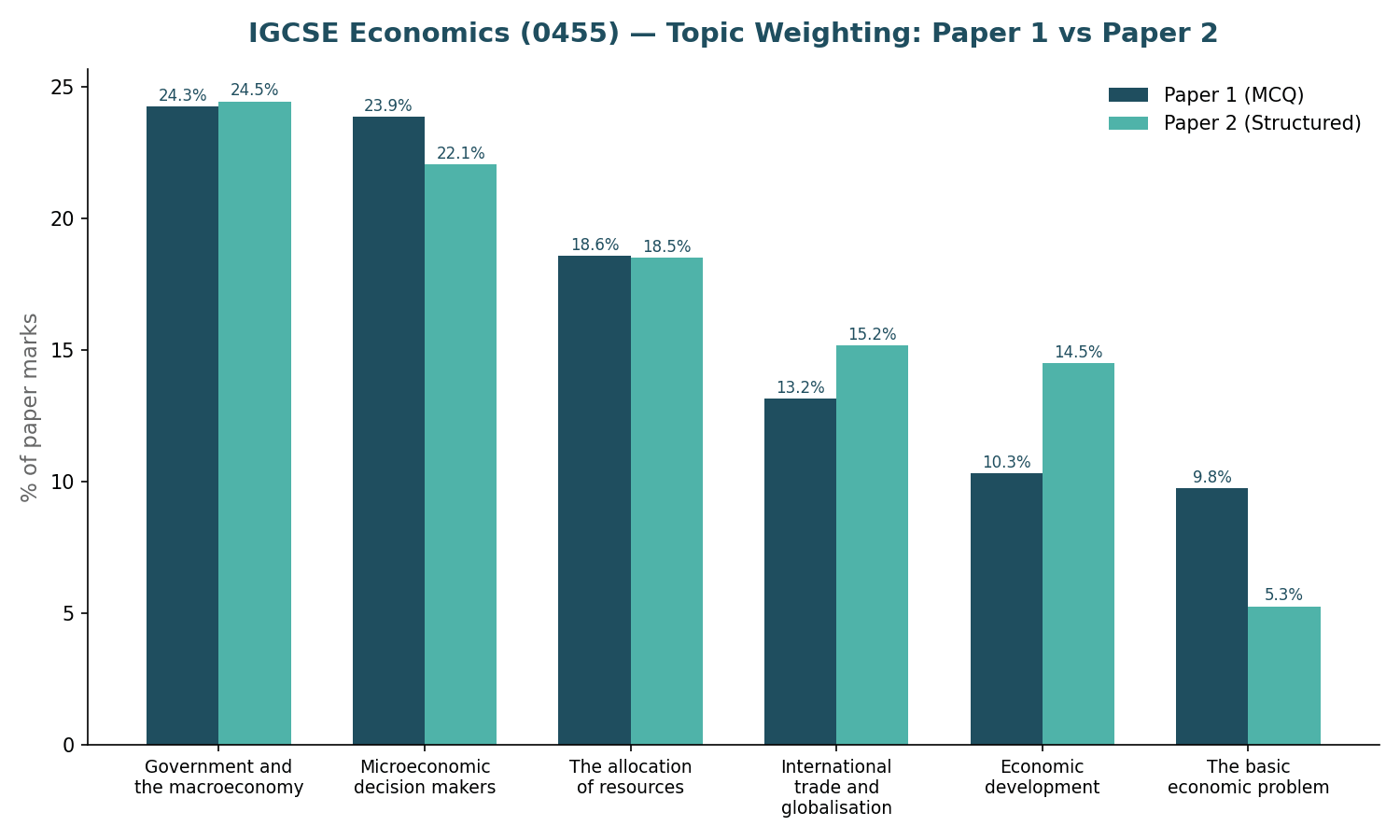
The real story is in the topics that don’t agree. Microeconomic decision makers is notably heavier on Paper 1 (23.9%) than Paper 2 (22.1%), while the reverse is true — more sharply — for two topics: International trade and globalisation (13.2% on Paper 1 vs. 15.2% on Paper 2) and especially Economic development, which nearly doubles its relative weight on the structured paper (10.3% vs. 14.5%). The basic economic problem shows the widest gap of all, at 9.8% on Paper 1 but only 5.3% on Paper 2 — this topic is tested almost twice as often, proportionally, in multiple-choice form as it is in extended structured answers.
This makes sense in light of question design: Economic development and International trade lend themselves naturally to the data-response, essay-style questions that dominate Paper 2 — interpreting development indicators, discussing trade policy trade-offs — while The basic economic problem’s foundational definitions and PPC-diagram concepts are more efficiently tested as quick multiple-choice items on Paper 1.
One subject-wide pattern only becomes visible when both papers are viewed together: every topic that ranks in the top 3 by marks on Paper 1 also ranks in the top 3 on Paper 2 (Government and the macroeconomy, Microeconomic decision makers, The allocation of resources — just with the order of #2 and #3 sometimes shifting), while the bottom 3 topics are consistently the bottom 3 on both papers too. The exam’s core priorities are, in that sense, paper-format-independent — it’s only the relative emphasis among the lower-weighted topics that shifts with format.
Focus Areas for Upcoming Exams
Based on eight years of Paper 1 data and seven years of Paper 2 data, a few patterns stand out for revision planning:
- Government and the macroeconomy is the single highest-priority topic on both papers — particularly Fiscal policy and Inflation and deflation, which lead their sub-topic rankings on both Paper 1 and Paper 2.
- Microeconomic decision makers and The allocation of resources round out the consistently heavy topics — on Paper 2 specifically, watch Firms and Mixed economic system, the two heaviest individual sub-topics on the whole paper.
- For Paper 2 specifically, sub-topics like The role of government, Supply-side policy and Trade unions appear less often but carry high marks per question when they do — worth solid preparation even though they’re lower-frequency.
- If sitting Paper 1, don’t under-prepare The basic economic problem — it’s the lightest topic on Paper 2 but holds a meaningfully larger share on the multiple-choice paper.
- If sitting Paper 2, give proportionally more attention to Economic development and International trade and globalisation than Paper 1 patterns alone would suggest.
Remember: these are historical patterns, not guarantees — a well-rounded revision plan should still cover the full syllabus. For topic-by-topic practice built around exactly this kind of breakdown, explore our IGCSE Economics (0455) Yearly & Topical Past Papers.