



Where the Marks Really Go: A Topic Trend Analysis of IGCSE Business Studies (0450) Paper 1
If you’re preparing for IGCSE Business Studies (0450) Paper 1, one of the most useful things you can do isn’t just practising past papers — it’s understanding how the marks and questions have historically been distributed across the syllabus. This report analyses seven years of Paper 1 data (2018–2024), cross-referencing how many marks each topic has carried against how often it has actually appeared in questions. The result is a clearer picture of where your revision time is likely to pay off most, and where frequency and mark-value don’t always line up the way you’d expect.
Overall Topic Distribution
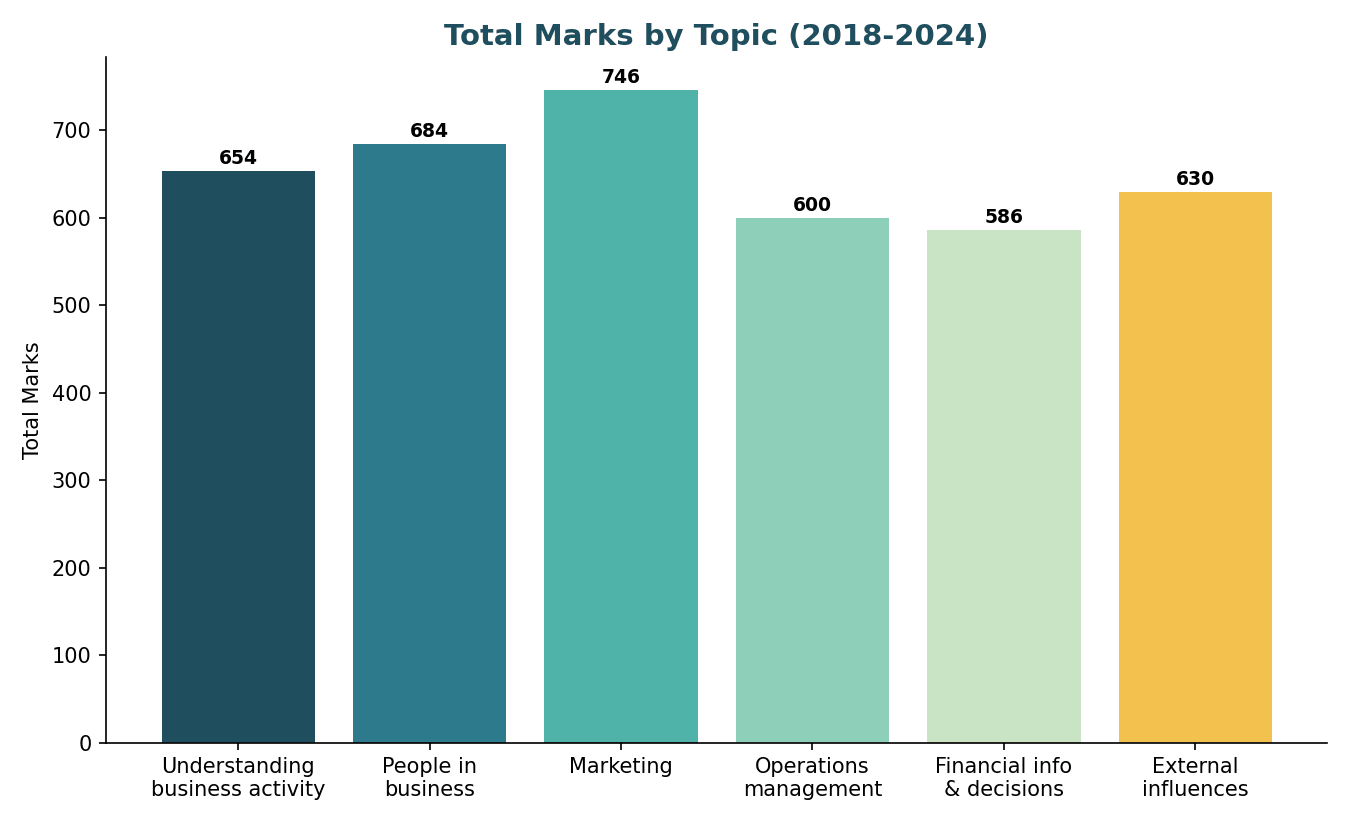
Across the seven years analysed, the six syllabus topics are allocated relatively evenly — no single topic dominates the paper, which is itself an important takeaway for revision planning. Marketing narrowly leads in total marks (746 marks, 19.1% of the paper), followed by People in Business (684 marks, 17.5%) and Understanding Business Activity (654 marks, 16.8%). At the other end, Financial Information and Decisions and Operations Management carry the least weight, at 15.0% and 15.4% respectively.
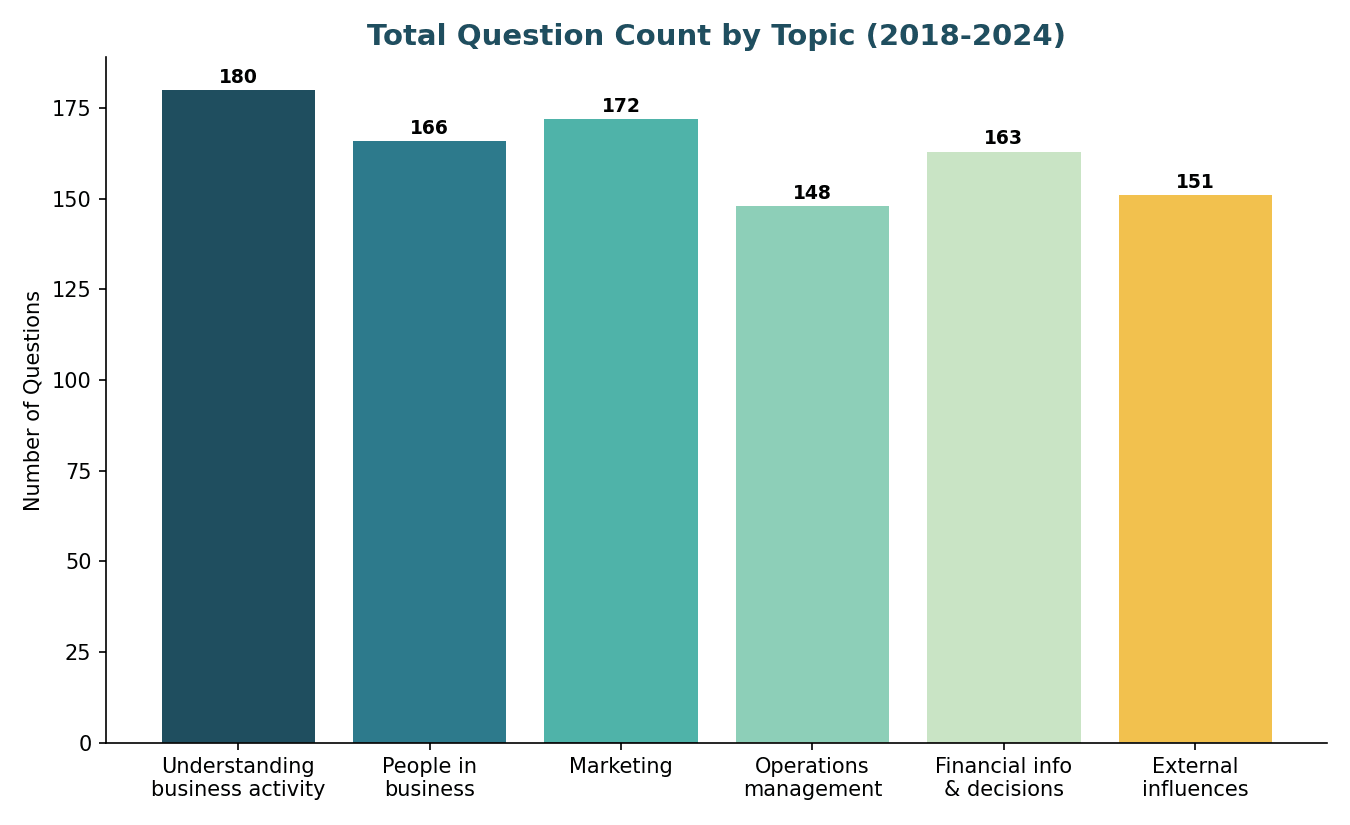
Question frequency tells a slightly different story. Understanding Business Activity is actually the most frequently examined topic (180 questions, 18.4% of all questions), even though it ranks only third by marks. Marketing and People in Business again feature near the top of both rankings, confirming they’re consistently central to the paper.
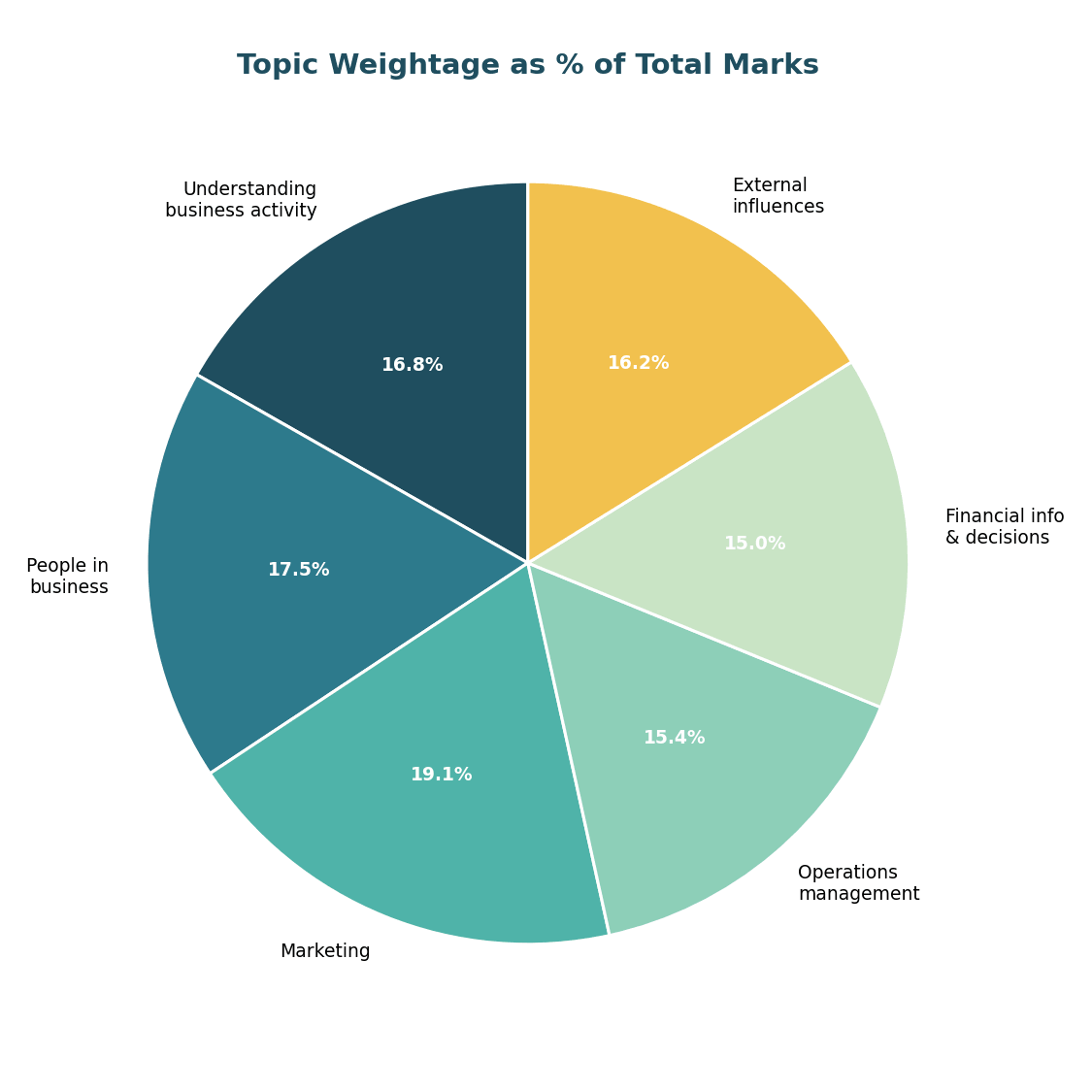
The pie chart above makes the balance clear: with all six topics sitting between 15% and 19% of total marks, Paper 1 doesn’t reward narrowing your revision to just one or two areas. Full syllabus coverage matters more here than in subjects with a heavily skewed topic weighting.
Sub-Topic Deep Dive: The Three Highest-Weighted Topics
Marketing (746 marks / 172 questions)
Marketing mix is by far the dominant sub-topic here, accounting for 426 marks across 92 questions — more than half of everything examined under Marketing. Marketing, competition and the customer (196 marks, 51 questions) and Market research (108 marks, 24 questions) follow well behind, while Marketing strategy appears only rarely (16 marks, 5 questions), suggesting it plays a minor, supporting role rather than being independently examined at length.
People in Business (684 marks / 166 questions)
Recruitment, selection and training of employees stands out as the clear priority sub-topic, contributing 298 marks across 70 questions — over 40% of this topic’s total. Organisation and management (140 marks) and Motivating employees (132 marks) are examined at similar, moderate levels, while Internal and external communication is tested less often (23 questions) but yields a notably high 4.96 marks per question when it does appear — worth flagging for exam technique, since these questions tend to demand fuller, more developed answers.
Understanding Business Activity (654 marks / 180 questions)
This topic is led by Enterprise, business growth and size (238 marks, 64 questions) and Types of business organisation (206 marks, 52 questions), which together make up more than two-thirds of the topic’s marks. Business objectives and stakeholder objectives (130 marks) is moderately tested, while Business activity and Classification of businesses appear only occasionally and at low mark value — useful to know, but not where the bulk of marks in this topic are concentrated.
Frequency vs. Mark-Value: Where They Don’t Line Up
One of the more useful things this kind of analysis reveals is that how often a topic is examined and how many marks it’s worth per question aren’t always the same signal. A topic can turn up constantly but only ever in short, low-mark questions — or appear rarely but always attached to a substantial, multi-part answer.
- Location decisions — 5.52 marks per question (116 marks / 21 questions)
- Internal and external communication — 4.96 marks per question
- Business finance: needs and sources — 4.68 marks per question
- Classification of businesses — 2.29 marks per question (despite 14 separate appearances)
- Statement of financial position — 2.50 marks per question
- Costs, scale of production and break-even analysis — 2.68 marks per question
At the topic level, Financial Information and Decisions and Understanding Business Activity both average around 3.6 marks per question — the lowest of the six topics — while Marketing averages 4.34 marks per question, the highest. This reinforces Marketing’s importance: it’s not just examined often, it’s also where the more substantial, higher-value questions tend to sit.
Year-by-Year Trends (2018–2024)
Looking at how marks allocation has shifted year to year adds useful context on top of the seven-year averages above.
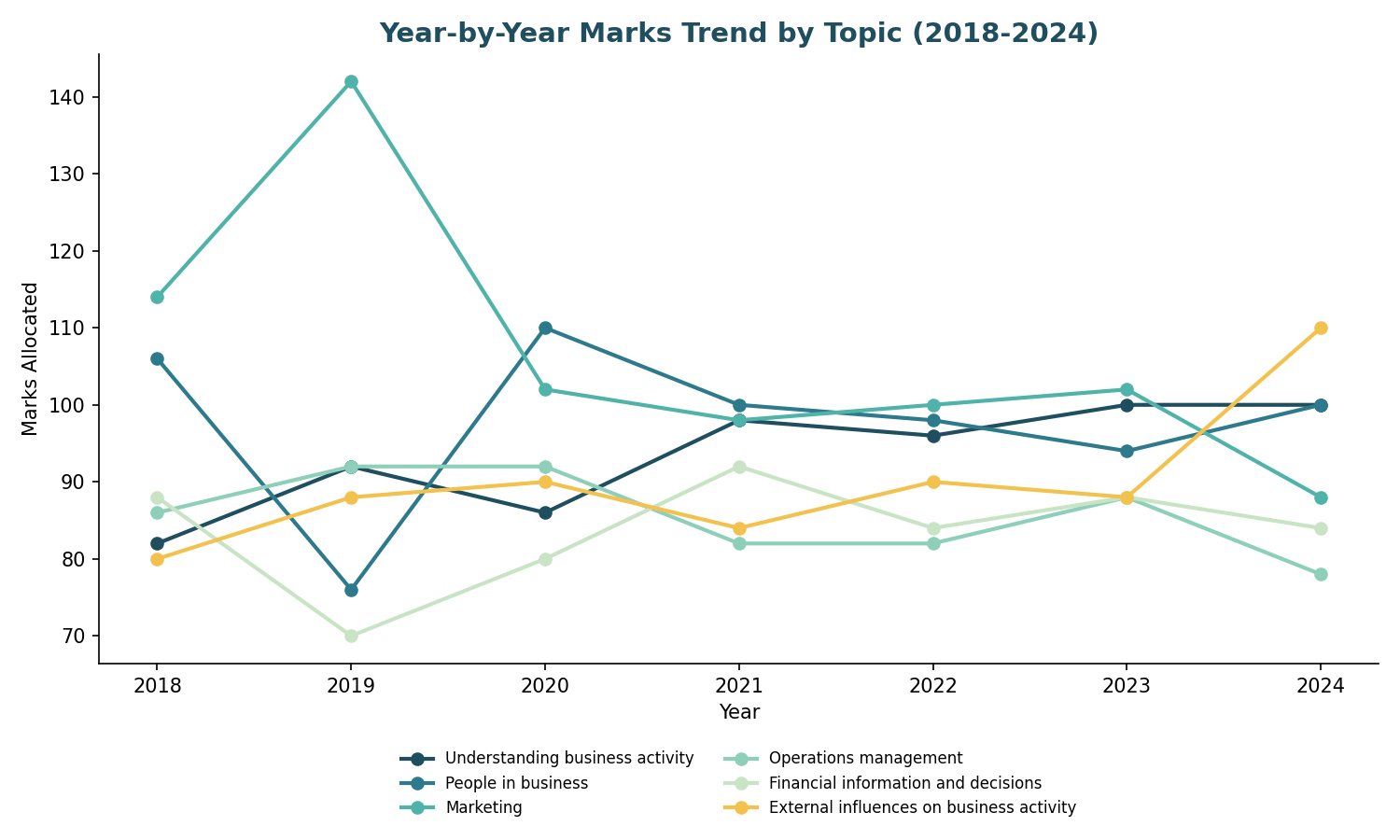
External Influences on Business Activity shows the clearest upward drift, rising from 80 marks in 2018 to 110 marks in 2024 — its highest point in the dataset. Understanding Business Activity has also trended gradually upward, holding at 100 marks in both 2023 and 2024 after starting closer to 82–86. By contrast, Marketing peaked in 2019 (142 marks) and has settled into a steadier 88–102 mark range in more recent sessions, while People in Business and Operations Management have both eased slightly from their earlier highs.
Summary Table: Topics Ranked by Marks and Frequency
| Topic | Total Marks | % of Marks | Total Questions | % of Questions | Marks / Question |
|---|---|---|---|---|---|
| Marketing | 746 | 19.1% | 172 | 17.6% | 4.34 |
| People in Business | 684 | 17.5% | 166 | 16.9% | 4.12 |
| Understanding Business Activity | 654 | 16.8% | 180 | 18.4% | 3.63 |
| External Influences on Business Activity | 630 | 16.2% | 151 | 15.4% | 4.17 |
| Operations Management | 600 | 15.4% | 148 | 15.1% | 4.05 |
| Financial Information and Decisions | 586 | 15.0% | 163 | 16.6% | 3.60 |
Focus Areas for Upcoming Exams
- Don’t neglect any topic — with all six topics between 15–19% of total marks, Paper 1 rewards genuinely balanced revision over concentrating on one or two areas.
- Prioritise Marketing Mix and Recruitment, Selection & Training — these two sub-topics alone account for a disproportionate share of marks within their respective topics and are worth extra practice time.
- Practise extended answers on Location Decisions, Communication, and Business Finance — these sub-topics carry the highest marks per question, so make sure answer technique (development, application, evaluation) is solid where these come up.
- Watch External Influences — it’s the topic with the clearest upward trend in recent sessions and may be worth extra attention this year.
- Don’t underestimate short-answer topics — Classification of Businesses and Statement of Financial Position appear frequently despite lower mark value, so quick, accurate recall still matters for these.
Analysis based on Examinent’s topical past paper mapping data for IGCSE Business Studies (0450) Paper 1, covering exam sessions from 2018 to 2024.
Recommended Resource:
👉 Explore our collection of IGCSE Business Studies Past Papers and Topical Questions PDFs , the perfect study companion to master every topic and practice effectively.